How to Choose the Right Microcontroller for IoT and Embedded Projects
Choosing the right microcontroller is key to building successful IoT and embedded projects. This guide compares ESP32, STM32, nRF52/nRF53, RP2040, and ESP8266, highlighting connectivity, power efficiency, performance, and use cases to help makers, students, and engineers make the best choice.


Importance of Choosing the Right Microcontroller
Selecting the right microcontroller (MCU) is critical to the success of any electronics project. The MCU acts as the brain of your system, influencing functionality, performance, and overall project outcomes. An appropriate MCU selection can enhance a project's capability by providing the necessary processing power, memory, and interfaces required to execute complex tasks efficiently.
One of the significant factors to consider is scalability. A well-chosen microcontroller not only meets the current needs of your project but can also accommodate future expansions. This adaptability is essential in environments characterized by rapidly changing technologies and user requirements. For instance, choosing an MCU that supports additional inputs or outputs allows for the incorporation of new features without requiring a complete redesign of your system.
In addition to scalability, the development time of your project can also be heavily influenced by your MCU choice. A microcontroller with a well-documented development environment and extensive community support can significantly reduce troubleshooting time. The availability of libraries and code examples can facilitate quicker development cycles, allowing for more productive iterations and faster deployment of the end product.
Cost-effectiveness is another significant aspect shaped by the selection of the right MCU. While some advanced microcontrollers may offer superior functionalities, they can also increase the project's overall costs through higher hardware expenses and longer development times. Conversely, selecting a simpler, lower-cost microcontroller may hinder your project’s potential. Therefore, the right balance must be struck to optimize both functionality and expenditure.
In summary, the importance of choosing the right microcontroller cannot be overstated. The selected MCU directly impacts scalability, development time, and cost-effectiveness, making it a pivotal decision that can ultimately determine the success of your project.
Overview of Popular Microcontrollers
Microcontrollers (MCUs) are integral components in modern electronic systems, providing the intelligence needed for various applications. This section discusses several popular microcontrollers that are frequently utilized in the industry, each known for specific features and functionalities.
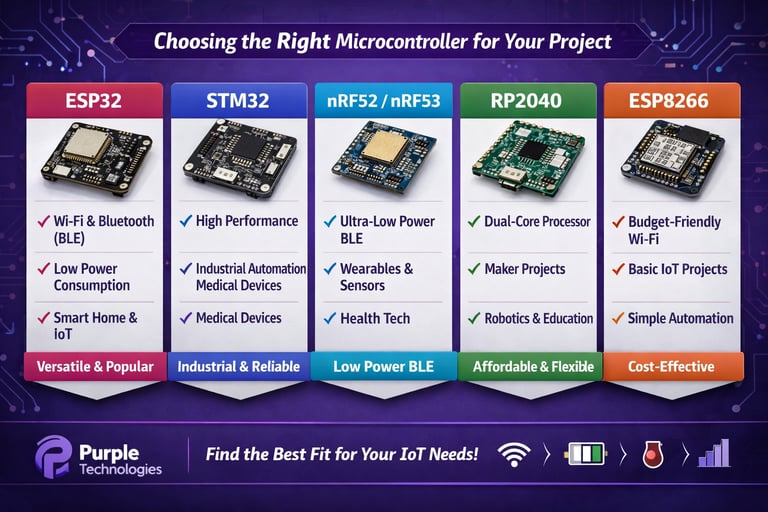
The ESP32 stands out due to its dual-core processor and integrated Wi-Fi and Bluetooth connectivity. This versatility makes it a popular choice for IoT (Internet of Things) applications, allowing developers to create a range of projects, from smart home devices to wearable tech. Its rich peripheral set and extensive community support further enhance its appeal.
In contrast, the STM32 family from STMicroelectronics offers a wide range of MCUs that are based on ARM Cortex cores. Known for their high performance and efficiency, these microcontrollers are suitable for consumer electronics, automotive applications, and industrial control systems. With various series tailored for specific tasks, users can select an STM32 MCU that best suits their power, size, and cost requirements.
The NRF52/53 series by Nordic Semiconductor is recognized for its low-power consumption and Bluetooth capability, making it ideal for battery-operated devices. This family is widely used in wearables, health monitoring, and remote controls, highlighting its strength in wireless communication.
Another popular choice is the RP2040, developed by Raspberry Pi. Designed for efficiency and ease of use, it features a unique dual-core processor and extensive GPIO capabilities. It has garnered popularity for educational projects and hobbyist applications, benefiting from the supportive online community involved in Raspberry Pi initiatives.
Lastly, the ESP8266 is an earlier yet influential MCU known for its low-cost Wi-Fi capabilities. It has laid the groundwork for IoT devices and continues to be favored in projects that require wireless connectivity, despite being eclipsed in functionality by the newer ESP32.
Each of these microcontrollers possesses unique attributes and strengths, enabling their application across diverse project types, from simple to complex systems.
Key Factors to Consider When Selecting a Microcontroller
Choosing the right microcontroller is a critical step in the development of embedded systems, and several key factors must be taken into account. The first important factor is connectivity options. Depending on the project’s needs, the microcontroller may require integrated support for communication protocols such as Wi-Fi, Bluetooth, UART, SPI, or I2C. These options facilitate the exchange of data with other devices and can influence the design and functionality of the overall system.
Next, power consumption is a crucial factor, particularly for battery-operated devices. A microcontroller with an efficient power management system can extend battery life significantly. Look for devices that offer various power modes or low-power operation features, as they can greatly enhance the longevity of portable applications. Understanding the power requirements will help align the microcontroller choice with the target application.
Processing performance is another vital aspect to consider. This includes the speed of the microcontroller’s clock, the number of cores, as well as the types of supported instructions. The project requirements will determine if a high-performance microcontroller is necessary or if a simpler solution suffices. The specific capabilities, such as computational power and memory resources, should match the demands of the tasks to be executed.
Lastly, cost can be a decisive factor in selecting a microcontroller. Budget constraints may limit the options available; therefore, a balance must be struck between performance and cost. Reviewing the pricing in relation to the features offered will help ensure that the selected microcontroller meets the project's requirements without exceeding the budget.
Comparative Analysis of Microcontrollers
The selection of a microcontroller unit (MCU) is pivotal in the development of electronic projects. Various microcontrollers cater to specific requirements based on their architecture, processing capabilities, and connectivity options. Here, we will analyze some leading microcontroller families: the Arduino, Raspberry Pi, and STM32.
Starting with the Arduino platform, it is designed primarily for beginners and hobbyists. The Arduino is equipped with a straightforward programming interface, making it an excellent choice for simple projects such as automated gardening systems or small robotic applications. However, its weaknesses lie in processing speed and limited connectivity options, which may hinder its performance in more advanced applications requiring real-time processing.
On the other hand, the Raspberry Pi microcontroller excels in computational power and multimedia processing. With built-in Wi-Fi and Bluetooth, it supports a broader range of connectivity options, suitable for projects like IoT devices or media centers. However, its complexity can be a double-edged sword, as it is not as user-friendly for novices as the Arduino.
Lastly, the STM32 series represents the more advanced end of the spectrum, offering high-performance ARM Cortex processors suitable for complex applications requiring multitasking and real-time operating systems (RTOS). Its robust connectivity options, including Ethernet and CAN bus support, make the STM32 ideal for industrial applications and automated systems. Nevertheless, it requires a steeper learning curve and can be overkill for simpler projects.
Choosing the right microcontroller ultimately depends on the specific needs of the project, including the required processing power, connectivity, and user-friendliness. By understanding the strengths and weaknesses of each option, developers can align their project needs with the appropriate MCU effectively.
Application Use Cases for Each Microcontroller
When selecting a microcontroller for a specific project, understanding the distinct application domains each microcontroller excels in is crucial. Microcontrollers can be broadly categorized based on their suitability for Internet of Things (IoT) devices, industrial automation, wearable technology, robotics, and educational projects
In the realm of IoT devices, microcontrollers such as the ESP8266 and ESP32 are popular due to their built-in Wi-Fi capabilities, making them ideal for smart home applications like automated lighting and temperature control systems. These microcontrollers facilitate seamless data communication over the internet, which is a fundamental requirement for connected devices.
On the other hand, industrial automation projects often demand robust performance and reliability. Microcontrollers like the STM32 series are suitable for such tasks due to their high-performance ARM Cortex-M cores and support for real-time operations. These attributes make them a prevalent choice in controlling machinery, sensors, and actuators in industrial settings.
For wearable technology, microcontrollers such as the Nordic nRF52832 and nRF52840 have gained popularity due to their low power consumption and Bluetooth Low Energy (BLE) capabilities. These features allow for the development of devices that can run for extended periods on small batteries, which is essential for wearables like fitness trackers and smartwatches.
In robotics, versatile microcontrollers like the Arduino Mega provide a broad array of input/output options and compatibility with various sensors and motors. The Arduino platform is widely used in educational settings for prototyping robots, allowing students to easily assemble and program their projects.
Lastly, in education, microcontrollers like the Raspberry Pi and Arduino Uno serve as excellent platforms for teaching programming and electronics concepts. These microcontrollers not only support numerous learning resources but also foster hands-on experimentation, which is vital in understanding practical applications.
In conclusion, choosing the right microcontroller hinges on understanding the specific requirements of your project. Whether it's about leveraging IoT capabilities, ensuring reliability in industrial applications, or engaging students in education, the microcontroller used will significantly impact the project’s success.
Tips for Beginners and Professionals in MCU Selection
Selecting the right microcontroller unit (MCU) for your project can be a daunting task, especially for those new to electronics. However, understanding a few key factors can significantly ease the decision-making process. For both beginners and seasoned professionals, several practical tips can guide you in your selection.
First and foremost, identify your project requirements clearly. This involves defining the goals, desired features, and operational environment of your application. Whether it’s for a simple LED project or a complex IoT device, knowing the specifications helps narrow down your options. Consider parameters like processing power, memory size, input/output interfaces, and power consumption. The focus keyword here is 'microcontroller', which encapsulates these essential characteristics and plays a central role in your project’s success.
Another crucial tip is to review the performance metrics associated with potential MCUs. Researching and comparing CPU architecture, clock speed, and support for additional peripherals can provide insightful data on how well a microcontroller can perform under load. Utilizing resources such as data sheets, application notes, and user reviews can illuminate the practicalities and limitations of different models.
Moreover, avoid common pitfalls, such as overestimating your needs or ignoring future scalability. Many beginners may opt for the latest technology without assessing if it truly meets their project’s needs. Likewise, it's essential to consider the availability of development tools, support communities, and documentation. Extensive community support can be invaluable, particularly when troubleshooting or learning. Products that offer rich online resources can save time and enhance overall development efficiency.
In conclusion, thorough research and careful consideration of requirements and resources can empower both novices and professionals to make informed choices when selecting a microcontroller. By understanding the nuances of performance metrics and avoiding common traps, one will be better equipped to execute successful electronics projects.
Conclusion and Support from Purple Technologies
In selecting the right microcontroller for a project, multiple factors play a crucial role. These include processing power, memory capacity, peripheral options, development environment, and cost. Understanding the specific requirements of your project is essential to narrowing down the options effectively. Choosing a microcontroller that aligns with your project's technical specifications and your personal or professional skill level ensures optimal performance and user satisfaction. Furthermore, it is important to consider the availability of community support and development resources, which can greatly ease the debugging and development process.
Purple Technologies stands out as a valuable partner in navigating this selection process. They offer an extensive array of resources tailored to assist both beginners and experienced developers. From detailed product specifications to an abundance of reference designs, Purple Technologies provides comprehensive materials that can help inform your decision on the appropriate microcontroller. Their support services include knowledgeable technical assistance that can guide you through complex queries, ensuring that you make informed choices.
Moreover, their commitment to innovation means that customers can access the latest advancements in microcontroller technology, keeping your projects competitive and state-of-the-art. Purple Technologies also facilitates community engagement, offering platforms where developers can share insights and troubleshoot issues collaboratively. This focus on support greatly enhances the overall experience, particularly for those who may be new to microcontroller projects.
In conclusion, selecting the right microcontroller is pivotal for the success of your project. By leveraging the resources and support provided by Purple Technologies, developers can streamline their decision-making process and enhance their project outcomes, irrespective of their experience level.